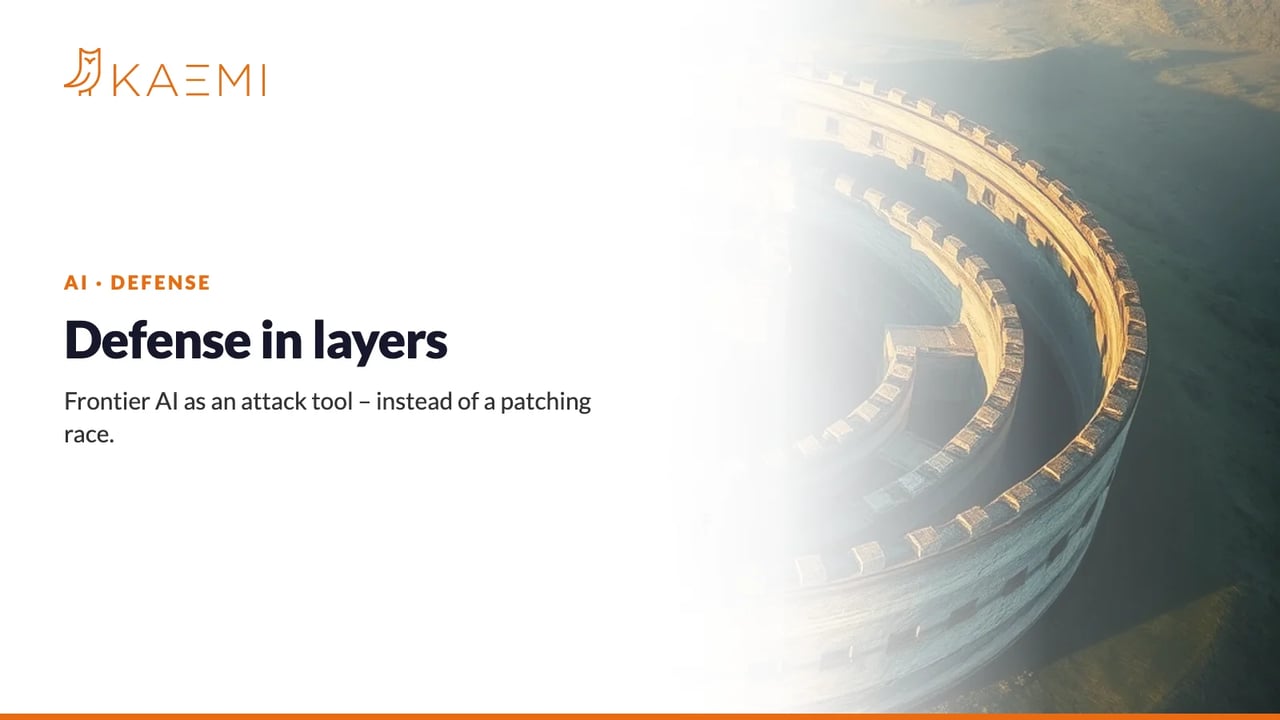
Frontier AI as an attack tool: defense in layers instead of a patching race
Frontier models, the most capable AI models of their generation, are changing the economics of cyberattacks. What used to take days or weeks of manual work, they finish in minutes: finding vulnerabilities in open-source libraries, constructing exploit chains, generating working attacks. In a recent post, Cloudflare described how it defends its own network as "Customer Zero" against this new class of attacks. The lessons from it are relevant for every company.
What frontier models change
Three shifts stand out. First, the speed at which new vulnerabilities are found. Second, the volume: AI mass-produces adaptive exploit variants that deliberately slip past traditional signature-based detection. Third, the reach: when a vulnerability is exploited, it no longer happens slowly and selectively, but fast and indiscriminately across entire attack surfaces. A twelve-hour patch window, long a solid standard, is no longer enough in this world.
Scores instead of signatures
The central answer: detection must no longer depend on an attack already being known. Instead of rigid signatures, an ML-based attack score rates every request on a scale of 1 to 99 and thereby catches novel variants before they are publicly documented. By its own account, Cloudflare can roll out new WAF rules within hours of a proof of concept becoming known; distribution across the entire network takes under 30 seconds. What makes this possible is visibility into a substantial share of web traffic, which serves as an early warning system.
Defense in layers
No single tool stops AI-accelerated attacks. The architecture described staggers several layers one behind the other: web application firewall, API validation, bot management, identity-based Zero Trust access, all the way to controlled access for AI tools. If one layer fails, the next one takes over. Regular red team exercises check whether it really holds up when it matters.
What companies can do now
The first step doesn't have to be big: enable traffic inspection, validate API schemas, turn on bot detection, and tie access to identities instead of network locations. What matters is the direction: away from a pure patching race, toward an architecture that also absorbs unknown attacks.
KAEMI implements these building blocks as a managed service, from WAF and API protection through bot management to Zero Trust access. For an overview, see our page on Application Security.
For a compact overview of all Cloudflare application security products, see our Cloudflare page.
Questions about how to build these layers of protection in your own environment? A message to sales@kaemi.io is all it takes.