Application Security with Cloudflare: Protecting Web Apps and APIs from One Platform
For many companies, web applications and APIs are the most important connection to customers and partners. That is why they are so often targeted: SQL injection and cross-site scripting aim at the application, credential stuffing at the logins and DDoS attacks at availability. In the past, each of these threats had its own appliance in the data centre. Cloudflare brings protection together on one platform that also handles delivery.
Security belongs in the delivery path, not beside it
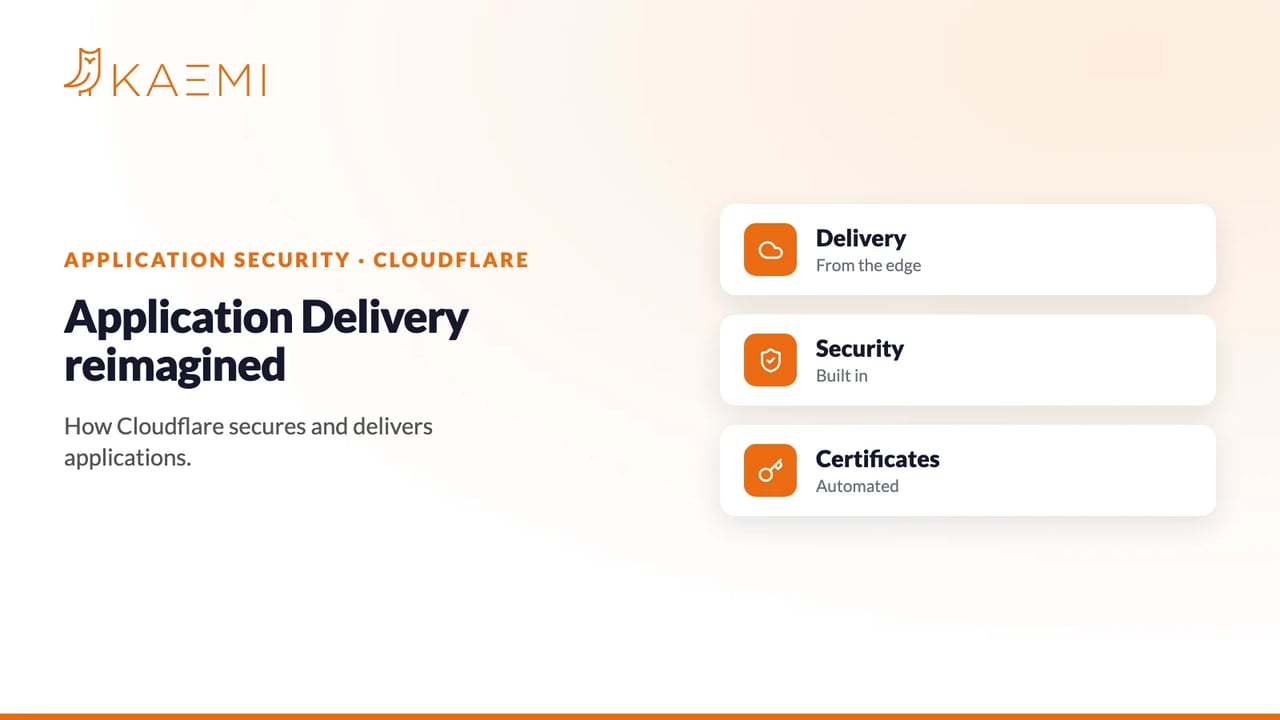
The real shift in perspective: application security is not a downstream add-on — it is part of delivery itself. Instead of routing traffic into the data center first and then through a chain of individual appliances, it is terminated, inspected, and protected at the global edge before it ever reaches your infrastructure. This is where Cloudflare comes in: network, delivery, and security converge in one cloud-native platform.
What Cloudflare offers for application security
Cloudflare bundles the building blocks that used to be spread across different appliances into one coherent stack:
Web Application Firewall (WAF): blocks attacks such as SQL injection, cross-site scripting, and zero-days via curated managed rulesets (including the OWASP Core Ruleset) and custom rules. All of it central and versionable, without an appliance at every site.
DDoS protection: automatic mitigation of attacks at the network, transport, and application layers (L3 to L7) across the global anycast network. The network absorbs the load before it reaches your origin.
Bot management: distinguishes real users from automated access and stops credential stuffing, scraping, and abuse without slowing down legitimate customers.
API security (API Shield & Gateway): schema validation, automatic API discovery, authentication, and rate limiting protect the interfaces modern applications use to communicate.
Page Shield: monitors client-side scripts and raises the alarm on tampering, for example Magecart and supply chain attacks in the browser.
SSL/TLS with automated certificate management: issuance and renewal run automatically. Short lifetimes go from being a problem to being a non-issue.
Load Balancing, Argo Smart Routing & Waiting Room: intelligent load distribution, optimized paths through the network, and fair queues during traffic spikes ensure performance and availability: the "delivery" in application delivery.
Automate instead of doing it by hand
To keep these building blocks from becoming another silo, their configuration belongs in code. Cloudflare is API-first and can be run entirely as infrastructure as code, for example with Terraform. WAF rules, rate limits and bot settings are then versioned in the Git repository, rolled out through pipelines and traceable at any time.
The same applies to certificates. Once their lifetime drops to 47 days by 2029, renewal can no longer be handled manually. What that means for your environment is covered in our article on 47-day certificates.
Our view at KAEMI
We think application delivery and application security together, aligned with your requirements. As a Cloudflare partner, we plan, implement, and manage these building blocks as a managed service: WAF, DDoS, bot, and API protection, automated certificate management, and high-performance delivery — introduced step by step and grounded in the reality of your applications.
You can find out more about how we secure web applications and APIs on our application security page.