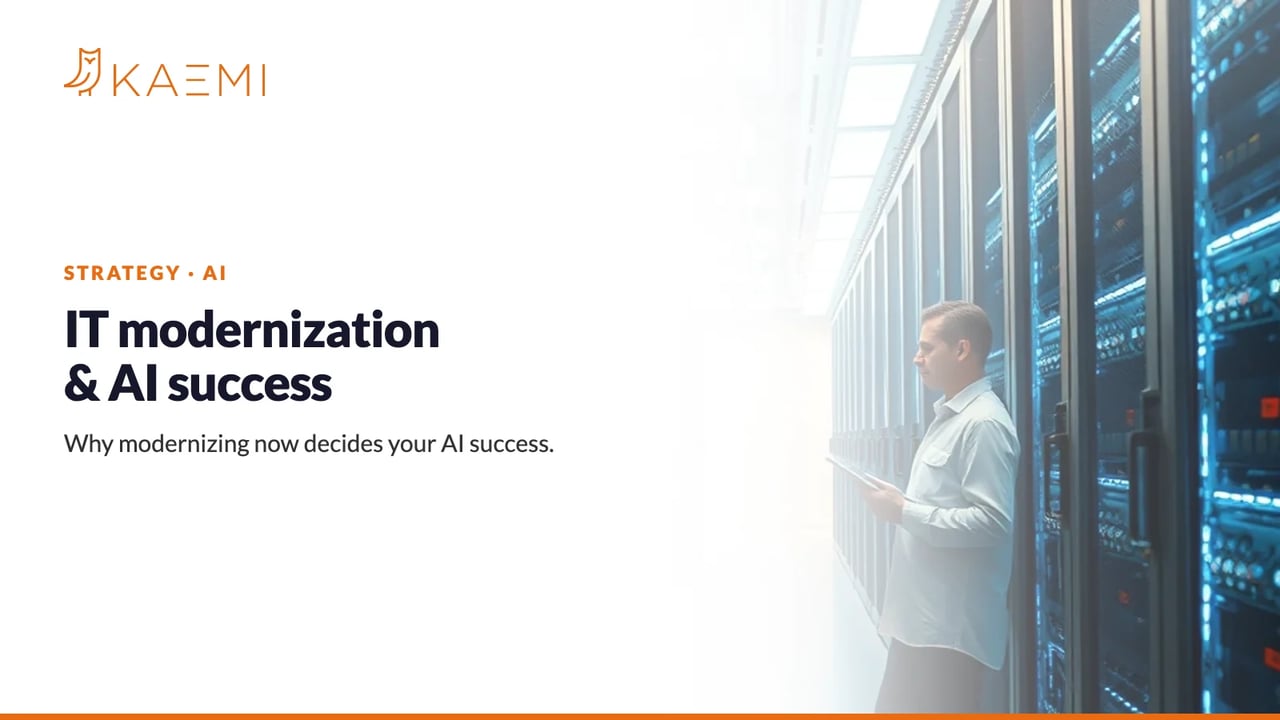
Why IT Modernization Determines Your AI Success
The pressure on executives to gain competitive advantages with artificial intelligence is growing. According to Cloudflare's 2026 application innovation report, 74 percent of leading companies want to expand their AI integration in the coming year. At the same time, many organizations are simply not prepared for it. That foundation determines your AI success.
A Gartner forecast shows how large the gap is: by the end of 2027, more than 40 percent of agentic AI projects will be canceled. The analyst firm cites rising costs, unclear business value, and insufficient risk controls as the reasons.
The problem is rarely ambition. It is architecture. Outdated systems, brittle integrations, and security gaps patched over the years hold companies back while expectations for innovation keep rising. This article shows why IT modernization is the foundation for AI and other new technologies, and how to build a convincing business case for it.
Innovation does not grow on legacy systems
The problem is not limited to AI. Without modern applications, connected data, and secure, scalable infrastructure, innovation projects fall short of their potential or fail expensively. Technical debt, data silos, and security problems surface in ways that undermine success from within.
IT modernization has an image problem. Renewing your own infrastructure looks less attractive than launching a new platform or product. Modernization therefore often becomes a side project, pursued half-heartedly and quickly deprioritized in favor of visible, customer-facing initiatives. The result: IT teams spend their time maintaining old systems and fixing performance problems while new requirements sit untouched.
The numbers speak clearly. 49 percent of IT leaders name AI as the most important driver of new modernization initiatives, and almost 90 percent of companies expect rising budgets for application modernization in the coming year. Those who invest wisely set a self-reinforcing cycle in motion: gains in efficiency and agility strengthen the business case for further investment, and that investment drives long-term growth.
Five arguments that land in the boardroom
Anyone making the case for IT modernization should argue in terms of business outcomes rather than technical details. Five levers contribute directly to goals every executive team understands:
- Reduce technical debt: Legacy systems with outdated code and illogical workarounds are expensive to keep running, insecure, and laborious to maintain. 40 percent of companies make little progress on modernization because their developers lack the time. The front-runners show the opposite: more than half deliberately focus their development work on maintaining and modernizing existing systems, which keeps them free to act on expansion, AI adoption, and new products.
- Enable global growth: Applications must be secure, available, and fast for customers worldwide. 71 percent of organizations believe they can support a global user base without difficulty; in practice, however, compliance, consistent customer experiences, and operating across markets remain demanding. Modern, cloud-native systems scale with demand without compromising the customer experience.
- Improve the customer experience: Slow or unreliable applications cost loyalty. 44 percent of companies observe growing dissatisfaction with sluggish applications, and 46 percent of users do not return to poorly performing websites. Developers who are no longer repairing legacy systems build features customers can feel instead.
- Increase agility: With modern infrastructure, teams respond faster to market changes and customer needs. Time that used to flow into system maintenance and risk remediation becomes available for value-adding work.
- Strengthen security: Where too little is invested, gaps stay open, from phishing to supply chain attacks. The consequences range from downtime to fines to reputational damage; 37 percent of organizations name system recovery as the biggest cost factor in security incidents. Those who modernize according to the principle of security by design spend less time remediating incidents and more time building resilient foundations.
Positioning modernization as a strategic necessity
The key lies in the positioning: IT modernization is not an optional upgrade and not a cost center. Presented correctly, the executive team understands that these investments directly enable faster innovation, higher profitability, and better customer experiences. Inaction, by contrast, has a measurable price: every year of delay grows the technical debt, ties up IT resources, and widens the gap to the digital front-runners.
One side effect is often underestimated: good developers want to work with modern tools, cloud infrastructure, AI, and automation. A modern technical foundation therefore also helps in the competition for talent.
IT modernization with KAEMI
As a managed security service provider, KAEMI supports companies along this path: from taking stock of the existing environment, to modernizing network and security, to cloud and AI infrastructure that grows with your requirements. Our Professional Services structure the first steps, and we take on the ongoing management with clear response times. This turns the modernization effort into a plannable project with measurable results.
Want to know where your environment stands today? Talk to us.
This article draws on Cloudflare's theNET article ("Why IT modernization matters") together with Cloudflare's 2026 application innovation report, as well as the Gartner forecast on agentic AI projects.