Data Loss Prevention (DLP): protecting sensitive data with Cloudflare One
The biggest threat to sensitive data often sits inside the company, not outside: an email to the wrong recipient, an upload to the wrong cloud, a copied customer record. Data Loss Prevention (DLP) bundles the strategies, processes, and technologies that prevent exactly that, whether accidental or deliberate. With GDPR and NIS2 in force, this has long been mandatory. The question is how to implement DLP today without creating yet another silo. Protecting sensitive data starts at the moment it is about to leave the network.
What DLP has to deliver: three data states
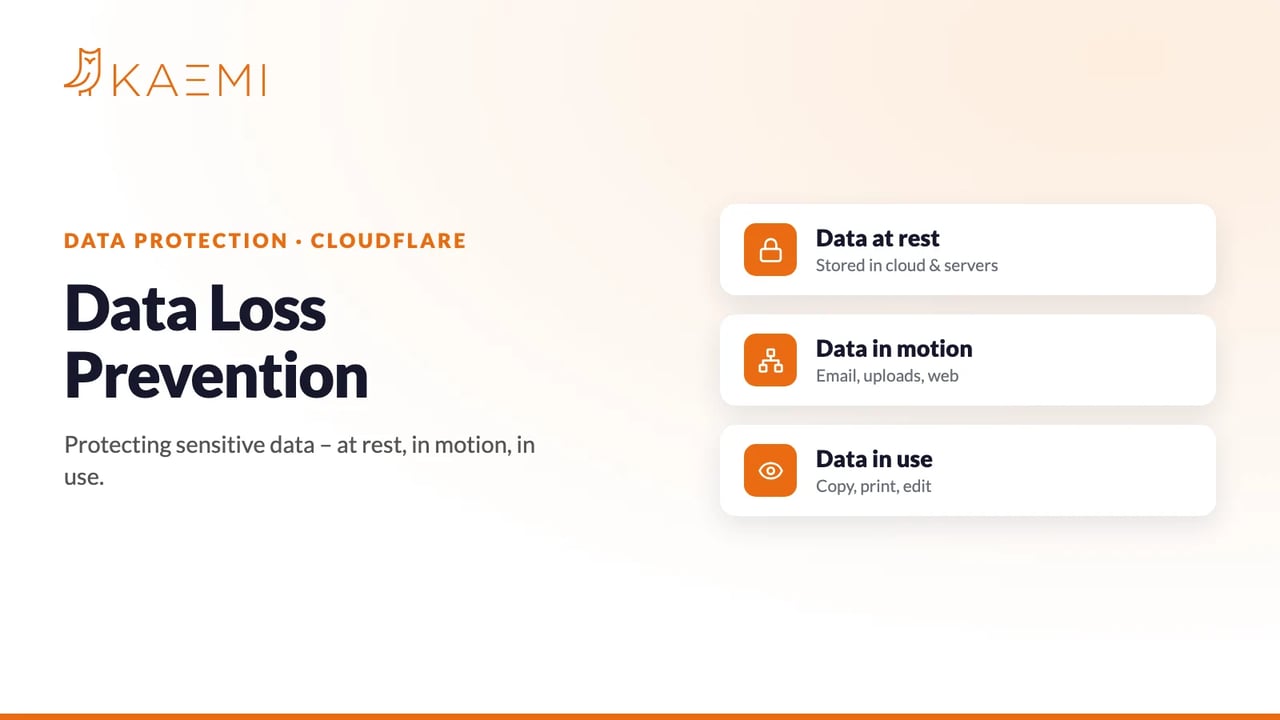
Effective DLP protects data in all three states instead of at a single point:
Data at rest: stored information on servers and in cloud services, such as files in SaaS applications.
Data in motion: data in transit (email, web uploads, data transfers).
Data in use: data being actively worked on (copying, printing, pasting into other applications).
Why traditional DLP often reaches its limits
Traditional DLP projects rarely fail on principle. They fail in execution: agent-heavy endpoint solutions that take real effort to run; rule sets that either generate too many false positives or match too coarsely; and point solutions that only see the endpoint but not web and cloud traffic. A modern approach puts DLP where the data already flows: into the security platform at the edge.
DLP as part of the platform: Cloudflare One
Cloudflare One integrates DLP directly into the SASE/SSE platform instead of placing it alongside as a separate product. Traffic is inspected at the global edge, inline and in real time:
Inline scanning via the Secure Web Gateway: outbound web and upload traffic is inspected for sensitive content and blocked if necessary, before the data leaves the company.
Predefined and custom profiles: detection of personal data, credit card and ID numbers, or source code via ready-made patterns, extended with your own company-specific data types.
Cloud data via CASB: data at rest in SaaS services can also be checked for misconfigurations and openly shared sensitive files.
One rule set instead of many silos: DLP draws on the same identity and access rules as Zero Trust Access and Gateway. One context, one policy.
Five steps to effective DLP
1. Classify: identify and categorize sensitive data types (personal data, financial data, intellectual property, contracts).
2. Control access: role-based and following the least-privilege principle, defining who may see and move which data.
3. Monitor: observe data flows continuously (at rest, in motion, and in use).
4. Respond automatically: block, warn, or log as soon as a policy is triggered.
5. Review and adjust: adapt policies regularly to new data, processes, and requirements.
Compliance: keeping GDPR and NIS2 in view
DLP protects and documents at the same time. If you know which data flows where and who accesses it, you can meet disclosure and reporting obligations and, if it comes to that, demonstrate that appropriate measures were in place. GDPR and NIS2 demand exactly this traceability, and a platform-based DLP delivers it as a byproduct of the ongoing managed service.
Our view at KAEMI
DLP works best as an integrated part of an end-to-end security architecture. As a Cloudflare partner, we plan, implement, and manage DLP within Cloudflare One as a managed service, aligned with your requirements and rolled out in phases rather than a big bang. That way you protect sensitive data in all three states without having to run yet another tool in isolation.