
The Bot-Dominated Internet: Why Your Architecture Must Ask About Intent
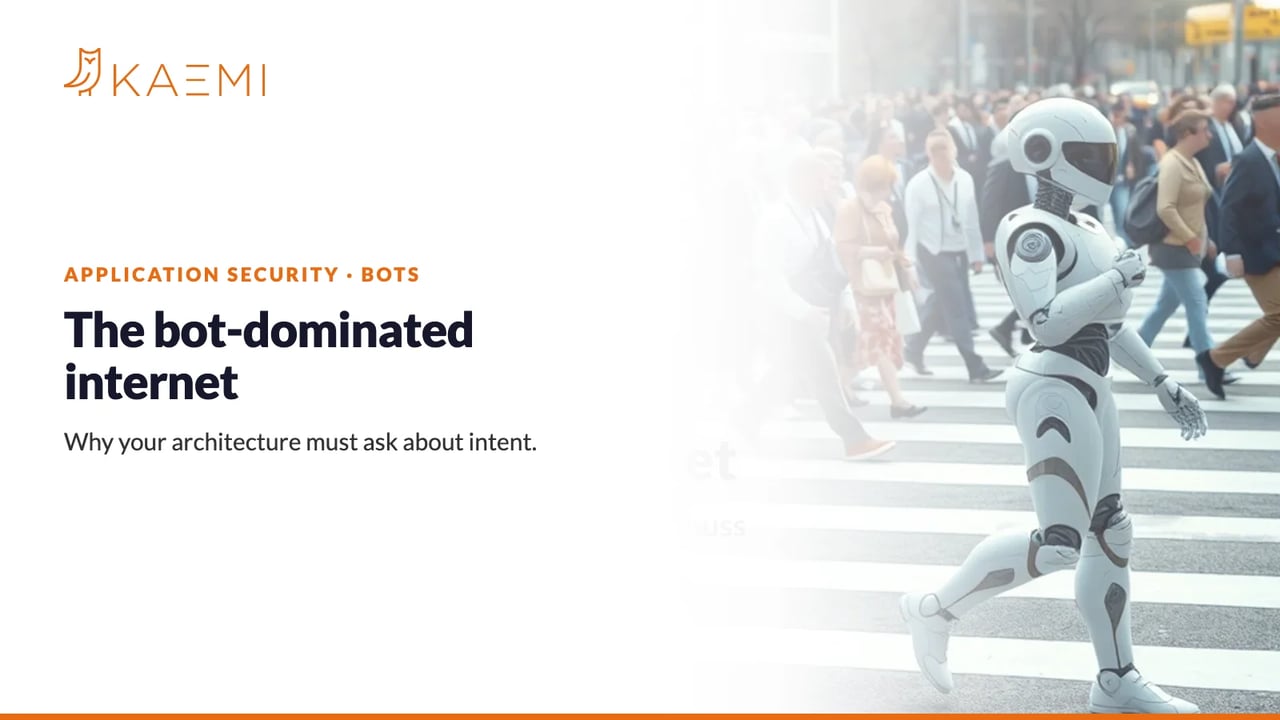
The internet was built for humans. By now, machines define it: nearly a third of all internet activity today comes from bots, and the share keeps rising. While humans click, scroll, and type, automated systems do their work in the background. Search crawlers index content, monitoring services check availability, APIs exchange data, AI agents process requests.
Most of this traffic is legitimate and keeps the internet running. A substantial share is not. And the line between the two is increasingly blurred. This post looks at why traditional security architectures fail in the face of this ambiguity, and at three principles for building an infrastructure that can handle a bot-dominated internet.
Good bots, bad bots: that is exactly the problem
If all automation were malicious, defending against it would be easy. In reality, companies face a double classification task: bot or human — and if bot, useful or harmful? Both are hard. Attackers disguise automated attacks as legitimate traffic, using rotating IP addresses, obscured identities, and imitated user behavior. Conversely, legitimate automation at scale often behaves so unpredictably that it looks suspicious even when it is not.
Traditional architectures were not built for this level of ambiguity. Perimeter-based models create latency and central points of failure. Multi-cloud and hybrid environments fragment policies and lead to inconsistent enforcement. Purely centralized systems do not scale fast enough; purely decentralized ones lose visibility and control. Above all, both can only tell you who is connecting. Whether an automated interaction helps or harms is decided by a different question: why is it there?
From security problem to architecture question
For decades, security was treated as a matter of detection and blocking, something you could delegate to the security stack. In a network dominated by automation, that reactive posture no longer holds. The goal is not to stop bots; the goal is to build an infrastructure that recognizes intent and adapts in real time. Bot defense thus turns from a product feature into a design principle: protection belongs embedded in the architecture, not bolted on afterwards.
More individual controls will not solve this. Tactical security solutions are outdated the moment they are rolled out, because threats evolve faster than manual response can follow. Three architecture principles point the way:
- Unify and consolidate: When policies and controls live in dozens of tools, no one has the full picture. A single, globally distributed platform applies one policy everywhere. A rule updated in one region takes effect across the entire network within seconds, not weeks.
- Evaluate behavior instead of rigid rules: Attackers change tactics constantly. Adaptive, ML-based systems analyze patterns of intent and velocity, distinguishing legitimate automation such as API calls or search crawlers from harmful activity, even when both look identical at first.
- Use good automation for defense: Automation is not the adversary — fragmentation is. Correlating network telemetry, bot signals, and application behavior automatically lets you detect and respond at machine speed and finally leave the reactive posture behind.
From "who" to "why"
The real shift in mindset lies in the guiding question. Instead of "Who are you?", modern architecture has to ask: "What are you trying to do?" In a world where machines, APIs, and AI agents will soon outnumber humans on the network, intent becomes the most reliable trust signal. Systems must evaluate purpose and behavior, not credentials alone, to decide whether an interaction is allowed, restricted, or denied.
Zero Trust evolves along the way: from a framework for human access into a code of conduct for the entire digital ecosystem. Every connection, human or machine, continuously verifies its identity, has its intent evaluated, and receives access only with minimal privileges, for a limited time, and under defined conditions.
What this means in practice
Platforms built along these lines combine central control with globally distributed enforcement. Cloudflare, for example, operates a network with one control plane spanning more than 335 cities: when bot management detects a new pattern, countermeasures take effect practically everywhere at once, and globally trained ML models spot anomalies in real time. What matters is the principle behind it, not the individual product: unified visibility across the security, network, and data layers, so response becomes possible without fragmentation or delay.
Bot management with KAEMI
For most companies, the path there starts at the network edge: bot management, WAF, and API protection as part of our Application Security, delivered as a managed service by KAEMI. For an overview of the Cloudflare products we use, see our Cloudflare page. And how identity-based access along Zero Trust lines fits into an overall architecture is covered in What is SASE/SSE?. Want to know how much bot traffic your applications really see today? Talk to us.
This post draws on the Cloudflare theNET article "The bot-dominated Internet" by Field CTO Nan Hao Maguire.