Shadow AI: When AI Becomes Shadow IT — and How SASE/SSE Contains It
Employees use ChatGPT & co. behind IT's back — sending confidential data out of the company. Why traditional firewalls don't see it, and how SASE/SSE with CASB, DLP, SWG and ZTNA makes uncontrolled AI use visible and contains it.
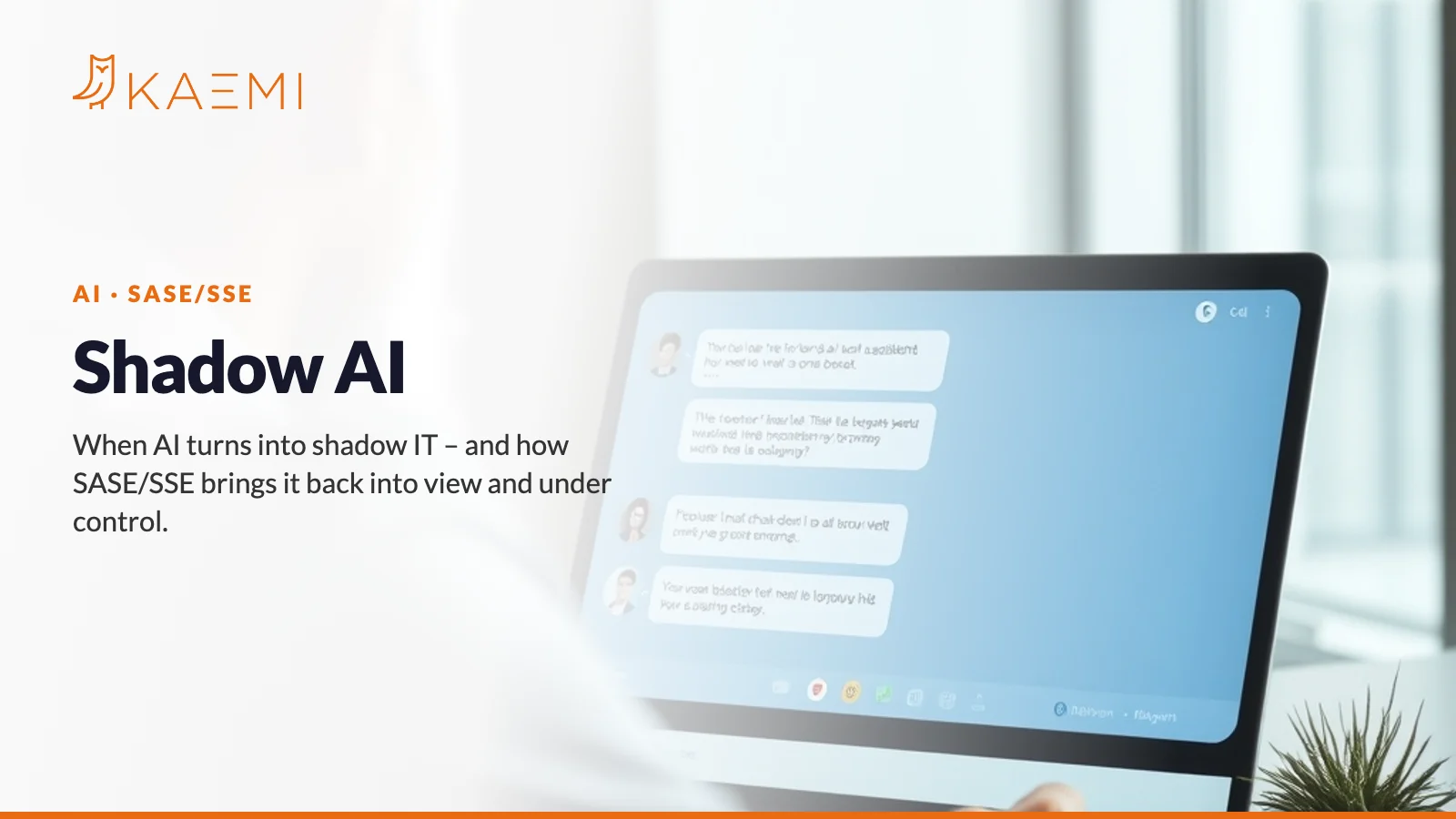
Generative AI has long since arrived in everyday work. Summarising texts, explaining code, drafting emails — and because it is so convenient, it often happens past IT. This is exactly where a new risk emerges: Shadow AI, the unofficial use of unapproved AI services. The colleague who quickly pastes a customer contract into a public chat model to summarise it means well — and in doing so sends confidential data out of the company.
This is not a fringe phenomenon. Surveys show that generative AI is already in use in individual departments at many companies, often without approval, without a policy, without IT even knowing. Shadow IT has always existed; AI merely makes it harder to spot and riskier.
Why Shadow AI is dangerous
The core problem is data leaving the building. Whatever ends up in an external service is beyond your control — stored, processed, perhaps even used for training. For customer data, contracts or internal know-how, that is not just annoying but a genuine data-protection and trade-secret problem.
On top of that comes regulatory pressure. The EU AI Act has been in force since 2024 and requires companies to know, classify and document their use of AI — with substantial fines for breaches. Anyone who does not even know which AI services are in use in-house cannot meet these obligations. Visibility is therefore no longer just a security question but a compliance one.
Why traditional controls fall short
The reflex to solve this with a firewall and VPN leads nowhere. These tools were built for a model in which traffic flowed through a central data centre and applications were known. AI services run in the cloud, the traffic is encrypted, and access happens directly from the endpoint — often bypassing the central gateway. A firewall that only sees ports and addresses cannot tell that a contract is travelling into a chat model inside a TLS-encrypted stream.
This is where the real gap opens up: you cannot control what you cannot see. Zero Trust is understood as a principle, but without the right architecture it stays theory.
How SASE/SSE contains Shadow AI
This visibility and enforcement is exactly what SASE/SSE delivers: a cloud-based layer that inspects traffic close to users and sites instead of forcing it through a distant data centre. Four building blocks work together against Shadow AI:
- CASB ( Cloud Access Security Broker ) makes visible which cloud and AI services are actually being used — including the ones nobody officially introduced — and lets you approve or block them deliberately.
- DLP (Data Loss Prevention) detects sensitive content — customer data, contract clauses, source code — and stops it from being uploaded to an unapproved service before it leaves the building.
- SWG (Secure Web Gateway) inspects web and TLS traffic inline and enforces the rules in real time instead of merely logging them.
- ZTNA ( Zero Trust Network Access ) replaces blanket VPN trust: access is granted only for verified identity and context, not to everyone on the network.
The decisive point is the combination. Only together do they produce a continuous picture: who is using which AI service, with what data, from which device? From that picture come policies that do not ban across the board but differentiate — for example: approved AI tool yes, but no data classified as confidential.
Technology alone is not enough
As important as the platform is, without rules it stays blunt. You need a clear AI policy: which tools are approved, which data classes may go in, who decides on new services? And you need the people: most Shadow AI incidents arise not from malice but from convenience and lack of awareness. Whoever makes the safe path — an approved, integrated AI tool — the easiest path has less to forbid.
A pragmatic start looks like this: first make visible which AI services are actually in use (the Shadow AI inventory almost always surprises). Then define data classes and an AI policy. Then enforce the rules via SASE/SSE — observing first, then blocking, so productivity does not suffer. And finally keep refining, because new AI services keep appearing.
This is exactly the cycle we manage at KAEMI as a service: establishing visibility, defining policies together with the company, enforcing them via the SASE/SSE platform and maintaining them in day-to-day operation. What such an architecture looks like across many sites and countries is shown in our case study on Cloudflare One in Europe .
Shadow AI does not disappear by banning AI — the tools are too useful, and users will find a way anyway. It disappears by turning uncontrolled use into controlled use: visible, governed, secured. SASE/SSE is the layer that makes that possible.