Why identity is the engine of Zero Trust
Zero Trust is often misunderstood as a collection of network controls or access technologies. In fact, Zero Trust is an architectural approach to access decisions. At its center sits identity. Since users, applications, and workloads have long been spread across cloud and hybrid environments, identity has replaced the network as the primary control point.
This post shows why every access decision begins with identity, how IAM, PAM, and IGA interact in the Zero Trust model, and where Zero Trust projects fail in practice.
What Zero Trust really means
The Zero Trust model discards the assumption that everything inside a network boundary is trustworthy. Instead, access is evaluated continuously: who or what is making the request, what is being accessed, and under which conditions? What matters is the insight behind it: Zero Trust is not a product but a decision model. Every access request must be explicitly verified and consistently enforced. NIST, the US standards institute, describes Zero Trust as an evolving set of security paradigms that shift the emphasis from static, network-based perimeters to users, assets, and resources.
Identity as the central decision input
In a Zero Trust architecture, access decisions are made at a policy decision point and enforced at a policy enforcement point; a control plane coordinates policies and telemetry. Identity feeds directly into this decision logic and answers the fundamental questions:
- Who or what is requesting access?
- How reliably has this identity been verified?
- What access should it have at this exact moment?
- Which risk signals are associated with the request?
Without strong identity controls, Zero Trust does not work. Network controls alone cannot decide whether someone may access a SaaS application, a cloud workload, or sensitive data. Only identity provides the context that makes such decisions meaningful. Analyst firms such as Gartner therefore consistently classify identity as a foundational, not merely supporting, element of Zero Trust architectures.
IAM as the enforcement layer
Identity and Access Management (IAM) puts Zero Trust into operation: it enforces access decisions at sign-in and during use. Traditional IAM mainly asked whether someone could authenticate. Zero Trust IAM asks whether access should be allowed at this moment, based on identity, context, and risk. Its load-bearing principles are:
- Strong authentication, including multi-factor and risk-based methods.
- Least-privilege access that limits permissions to what is necessary.
- Conditional access, where factors such as device health or risk level influence the decision.
- End-to-end visibility, so every access decision is logged and traceable.
Instead of granting broad access based on network presence, IAM enforces the policy at the identity level, consistently across SaaS applications, cloud platforms, and private systems.
IAM, PAM, and IGA working together
Three disciplines together ensure that access decisions remain correct, enforceable, and traceable:
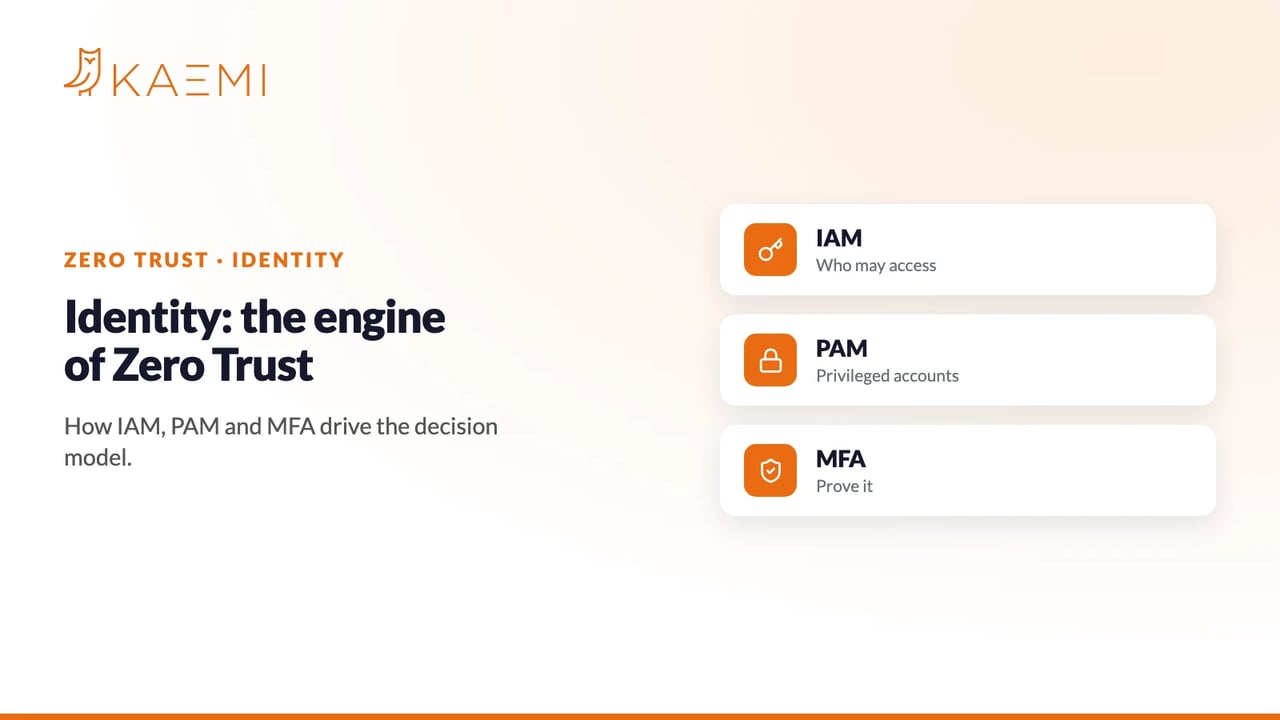
- IAM governs how identities authenticate, request access, and how that access is enforced across applications and services.
- Privileged Access Management (PAM) focuses on privileged access, such as administrative roles and far-reaching permissions whose misuse would have especially severe consequences.
- Identity Governance and Administration (IGA) provides governance: approvals, reviews, and auditable processes keep access rights correct over time.
PAM is especially important in the Zero Trust context because privileged access carries the highest risk. Standing administrator rights undermine Zero Trust because they bypass continuous verification. That is why privilege escalation needs to be controlled and privileged sessions monitored. IGA, in turn, keeps access decisions valid: if identities keep rights they no longer need, enforcement loses its point. Regular reviews and lifecycle controls keep policies aligned with reality.
From a network-centric to an identity-centric approach
Traditional security models leaned heavily on network segmentation and trusted zones. Zero Trust replaces that with identity-centric enforcement, a consequence of changed access patterns:
- Users access applications directly over the internet.
- Workloads authenticate to each other via machine identities.
- Devices move between networks without a consistently equal level of trust.
Across all these scenarios, identity forms a stable control point: whether a request comes from a remote user, a cloud workload, or an API, the same policy logic can be applied.
Typical pitfalls around identity
Many Zero Trust initiatives fall short of expectations because identity is treated as an afterthought instead of the foundation. Common problems include:
- Weak lifecycle management that leaves orphaned accounts and permissions behind.
- Inconsistent policies between IAM, PAM, and network controls.
- Relying too heavily on multi-factor authentication without enforcing least privilege.
- Little visibility into non-human identities and service accounts.
Zero Trust does not make strong identity hygiene unnecessary; it amplifies its importance. If identity data is incomplete or inaccurate, Zero Trust policies become unreliable.
Identity as the control plane
A mature Zero Trust approach treats identity as the control plane for access decisions: policies are defined once, enforced consistently, and supported by shared telemetry across identity, endpoint, and network controls. That reduces duplicated effort and creates clarity, because security teams think in terms of identity and policy instead of scattered individual rules. Identity is thus more than one control among many: it is the decision engine that connects authentication, authorization, privileges, and enforcement.
Why this matters now
Cloud adoption, remote work, and identity-based attacks make identity the basis of every access decision: it determines how access is verified and enforced. Organizations that make identity the foundation of their Zero Trust strategy gain clearer policy control and better visibility. Those that treat identity as secondary rarely get Zero Trust beyond isolated use cases. In short: Zero Trust begins with identity and stands or falls with how well it is managed.
How access, identity, and network can be bundled into one model in a cloud architecture is covered in the post What is SASE/SSE?.
As a managed security service provider, we at KAEMI plan, integrate, and manage identity and access architectures based on the Zero Trust principle, all from a single source. Want to make identity the foundation of your access strategy? Talk to us. We will assess where you stand and which steps are worth taking first.